With a tiered pricing model in the cloud, is it possible to use custom pricing in a multi-tenant setup?
Dusko Vukmanovic, CTO
11 December 2025

The multi-tenant setup refers to a scenario in which multiple users share the same cloud account to create resources. This arrangement involves a business entity – referred to as the company – that owns the cloud account and is responsible for paying the bill to the cloud vendor. Additionally, there are entities linked to the company, referred to as customers, who utilize this cloud account to create resources that operate under either commitments or credits, depending on the cloud vendor’s sales model.
In this setup, the company aims to sell credits to each customer using a custom price list. Customers benefit from this model since they cannot purchase more advantageous credits directly from the cloud vendor.
This situation does not seem to pose a problem for tools that manage cloud costs; companies simply need to implement them. The tool should support defining a custom price list for each customer, and the allocation process must read quantities from the cost and usage files, applying custom prices to accurately allocate costs.
However, the challenge is that the cloud billing data lacks information about the pricing model. Currently, only Azure’s FOCUS dataset provides information about tier usage, but it lacks crucial details regarding the specific tier being used.
Understanding cloud pricing model challenge
Cloud vendors typically use tiered pricing to establish the costs for their IaaS and PaaS offerings. This pricing model allows customers to benefit from a lower per-unit price within a specific tier. Once usage within that tier reaches its limit, customers advance to the next tier. Prices differ based on the tier selected. It’s important to note that the tier counters reset at the beginning of each billing period, which is usually monthly.
Table 1: An Example of a Tiered Pricing Model.
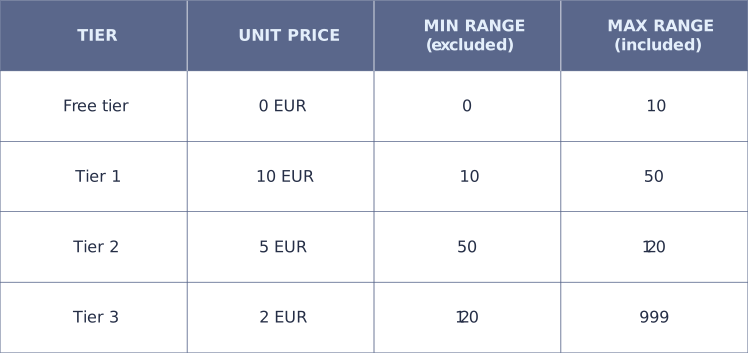
The price for a quantity of 100 is calculated by summing 10 units at 0 EUR, 40 units at 10 EUR each, and 50 units at 5 EUR each, which totals 650 EUR. The challenge lies in determining the current tier for a specific SKU when this information is not included in the cost and usage files generated by cloud vendors. In a multitenant environment, this complexity increases, as multiple customers may have varying tiers defined.
The allocation process is a solution for pricing management
Implementing custom pricing by adjusting the billing settings in your cloud provider’s console – where you would specify pricing tiers and applicable discounts based on usage – can be a daunting and unsustainable task for a large number of customers, even when cloud vendors would support this.
Allocation is a key capability of FinOps, establishing mechanisms to effectively distribute costs among various allocation groupings. However, implementing custom pricing within a volume-based tiered model presents challenges. The allocation process must enable cost processing by determining which tier each cost record belongs to and applying the corresponding price tier from the custom price list.
With an allocation system that understands the tiered pricing model, it is possible to assign different prices for existing tiers and to create entirely new tiers that operate independently of those set by the cloud vendor.
How can resellers use custom pricing strategically?
Whether you are a managed services provider (MSP), a holding company, or a government entity that manages cloud accounts and serves customers, consolidating customers can help you achieve volume while preserving the individuality of each customer through custom pricing. By grouping more customers under a single subscription, you can increase commitments and secure better discounts from cloud vendors, resulting in higher profits for resellers and greater savings for customers.
The MSP role can gain the following benefits:
- Create more comprehensive managed cloud offerings.
- Utilize lower tiers to attract clients, followed by opportunities for upselling.
- Align the internal cost structure with client tiers to maintain profit margins.
Build sophisticated pricing offering with CloudVane
The pricing you offer directly impacts your top-line revenue by attracting new customers and retaining long-term ones. By utilizing the right cloud billing system, you can achieve flexibility and profitability while delivering value to your customers.
CloudVane offers a comprehensive platform for managing cloud costs, granting businesses the flexibility to implement any pricing strategy. The platform is designed to facilitate the creation and deployment of sophisticated pricing structures.
With CloudVane, especially for showback and chargeback, you can:
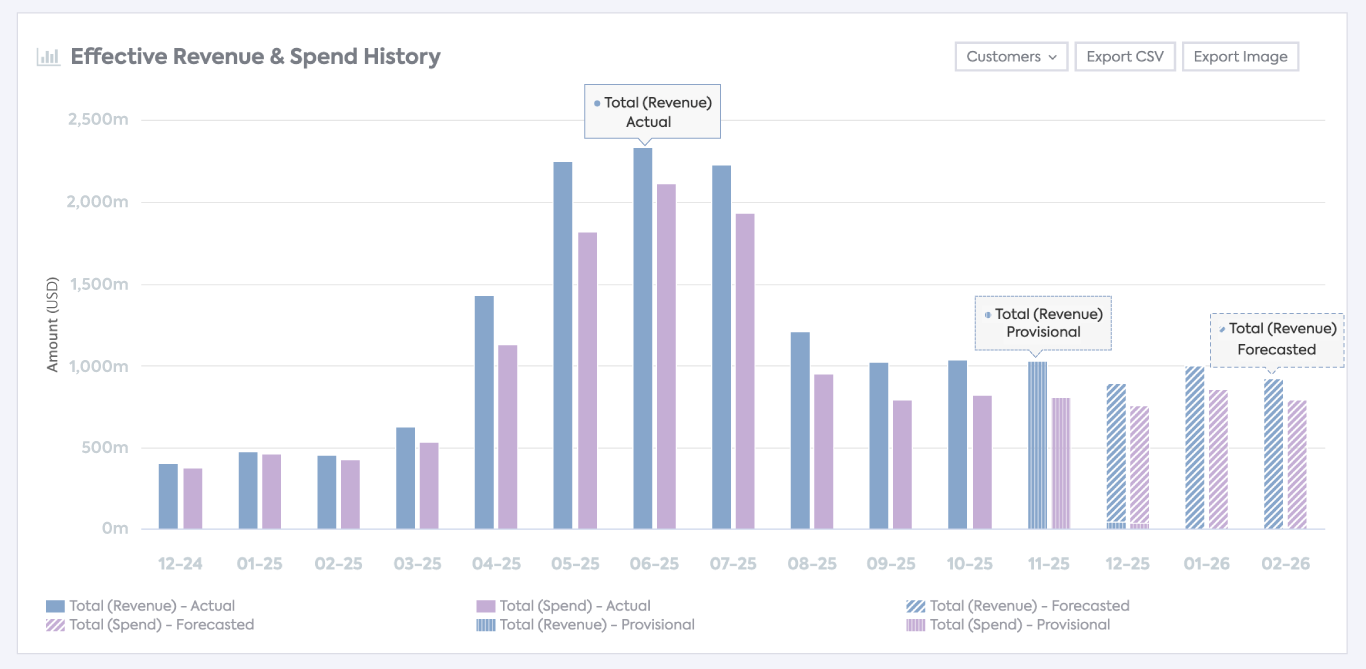
Figure 1: The Effective Revenue & Spend summary chart offers a clear profitability overview for all customers from the Managed Service Provider (MSP) perspective, including forecasts. The first bar represents MSP revenue, while the second bar shows the MSP costs owed to the cloud provider. Depending on the time frame, these costs can be categorized as actual, provisional, or forecasted. Provisional costs reflect expenses for an open billing period, and once that period concludes, these amounts are updated to reflect actual costs.
Conclusion
Custom pricing for reselling cloud services enables managed service providers (MSPs) to build sustainable cloud practices. This approach allows MSPs to customize their offerings to address the varied needs of customers while enhancing profitability.
At present, we assist resellers through our cost management platform, CloudVane. For more information about our case studies, please do not hesitate to reach out to us.
Related articles

The turning point in my Python journey: discovering Black, Ruff and mypy
June 24, 2026

Not all discount-bearing commitments follow the same model
April 21, 2026

MATCH_RECOGNIZE: A better way to detect patterns in your data
March 17, 2026
%HEADING%
%INTRO%